
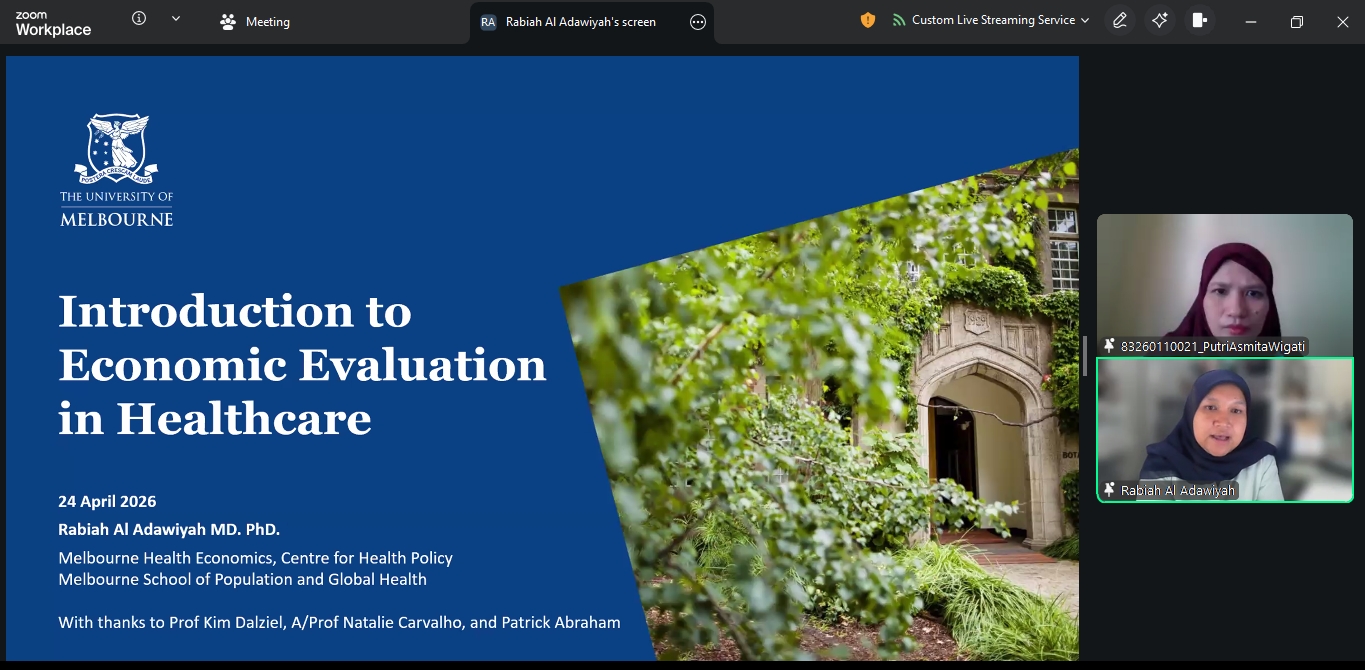
As a form of support for the development of a World-Class University, the Department of Health Administration and Policy, Faculty of Public Health, Universitas Diponegoro, contributed by hosting the UNDIP Global Classroom on the topic “Introduction to Economic Evaluation in Healthcare” on Friday, April 24, 2026. This event invited Rabiah Al Adawiyah, MD., Ph.D., from the University of Melbourne, and was moderated by Putri Asmita Wigati, SKM., M.Kes., Head of the AKK Department, FKM UNDIP. This event was part of the Health Economics and Financing course offered to all fourth-semester Public Health undergraduate students.
This UGC topic discussed the importance of health evaluation as a basis for decision-making in the health sector and supports Goal 3 of the Sustainable Development Goals (SDGs), namely “Good Health and Well-Being.” In her presentation, Rabiah Al Adawiyah, MD., PhD., emphasized the importance of economic evaluation in health to ensure the allocation of limited resources maximizes benefits, through approaches such as cost-effectiveness and cost-utility analysis. This material highlights the importance of efficiency, equitable access, and data-driven policymaking in supporting the success of health programs and the Sustainable Development Goals (SDGs). The session was complemented by an interactive discussion with participants.
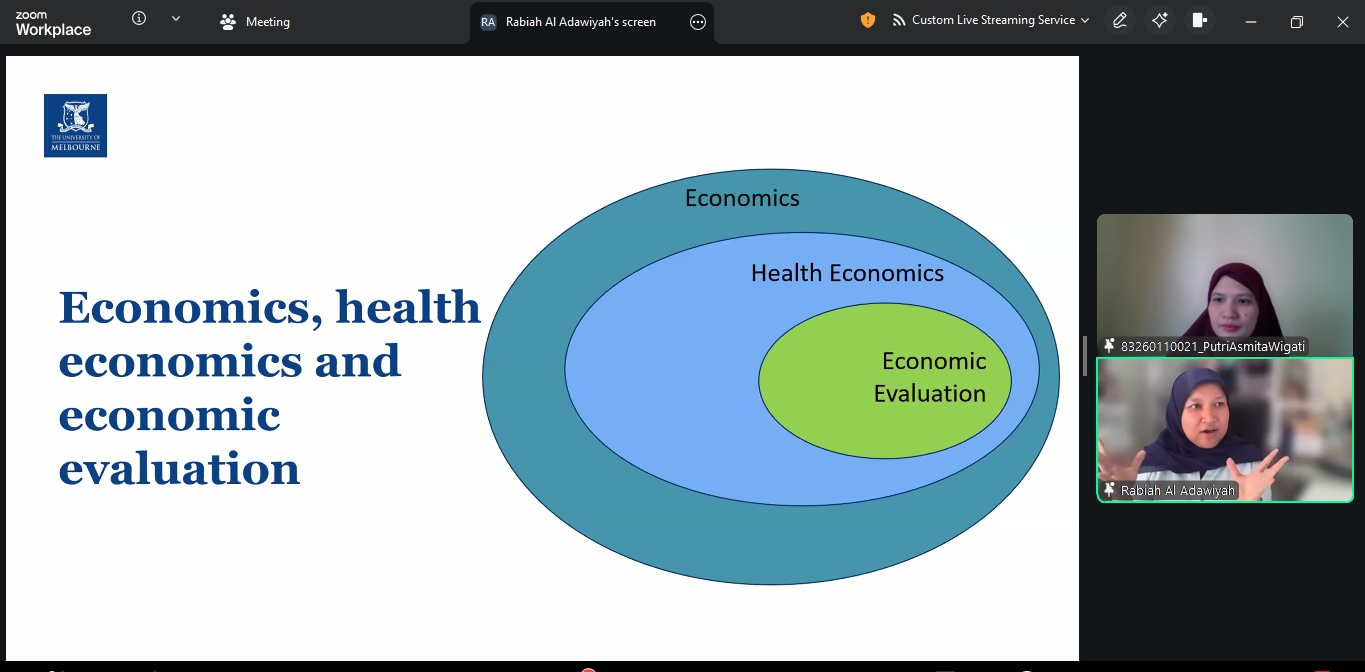
At the end of the session, the Head of the AKK Department, Putri Asmita Wigati, SKM., M.Kes conveyed that economic analysis methods are very varied and have a very important role for evidence-based decision making. Especially in health programs where a program must be designed by considering the benefits comprehensively and evenly for the entire community. With the UNDIP Global Classroom for the Economics and Health Financing course, it is hoped that students will gain an overview of economic evaluation and are expected to be more interested in studying the field of health economics so that in the future there will be more health economic evaluators in Indonesia. In addition, it is hoped that this activity can be the first step for FKM UNDIP, especially the AKK Section to establish further collaboration in the field of other tri dharma of higher education.