


SEMARANG, 30 Juli 2026. Fakultas Kesehatan Masyarakat Universitas Diponegoro menyelenggarakan The 7th International Conference on Public Health for Tropical and Coastal Development (ICOPH-TCD 2026) pada 29–30 Juli 2026. Konferensi yang berlangsung secara daring dengan tema “Strengthening Public Health Sustainability in Tropical and Coastal Areas” ini diikuti 224 peserta dari Indonesia, Australia, Republik Korea, Inggris, Amerika Serikat, Malaysia, Thailand, dan Tiongkok. Forum ini mempertemukan akademisi, peneliti, praktisi, mahasiswa, serta pemangku kebijakan untuk bertukar temuan ilmiah dan membahas solusi kesehatan masyarakat yang relevan bagi wilayah tropis dan pesisir.
Peserta dari delapan negara mengikuti pembukaan The 7th ICOPH-TCD 2026 yang diselenggarakan oleh Fakultas Kesehatan Masyarakat Universitas Diponegoro pada 29 dan 30 Juli 2026.
Rangkaian hari pertama diawali dengan sambutan Dekan Fakultas Kesehatan Masyarakat Universitas Diponegoro, Prof. Dr. Budiyono, SKM, M.Kes., kemudian dilanjutkan dengan pembukaan oleh
SEMARANG, 30 July 2026. The Faculty of Public Health, Universitas Diponegoro, organized the 7th International Conference on Public Health for Tropical and Coastal Development (ICOPH-TCD 2026) on 29–30 July 2026. Held online under the theme “Strengthening Public Health Sustainability in Tropical and Coastal Areas,” the conference brought together 224 participants from Indonesia, Australia, the Republic of Korea, the United Kingdom, the United States, Malaysia, Thailand, and China. The forum connected academics, researchers, practitioners, students, and policymakers to exchange scientific findings and discuss public health solutions relevant to tropical and coastal settings.
Participants from eight countries attend the opening of the 7th ICOPH-TCD 2026, organized by the Faculty of Public Health, Universitas Diponegoro, on 29 and 30 July 2026.
The first day began with welcoming remarks from the Dean of the Faculty of Public Health, Universitas Diponegoro, Prof. Dr. Budiyono, SKM, M.Kes., followed by the opening address from the Director of Reputation, Partnership, and Global Connectivity, Prof. Dr. Hadiyanto, ST, M.Sc., IPU. The main program then featured keynote addresses by Indonesian Minister of Health Budi Gunadi Sadikin and Indonesian Coordinating Minister for Human Development and Cultural Affairs Prof. Dr. Pratikno, M.Soc.Sc.
In his remarks, Prof. Dr. Budiyono positioned ICOPH-TCD as more than a venue for sharing research findings. Since the conference was first held in 2016, it has served to build institutional partnerships, expand research and community-engagement collaboration, encourage high-quality scientific publications, and create opportunities for visiting lectures, student exchange, and international educational cooperation. He noted that public health challenges in tropical and coastal regions require adaptive, sustainable, and locally responsive approaches.
Budi Gunadi Sadikin discussed the challenges of tropical infectious diseases in Indonesia and the need to strengthen a health system centered on surveillance and prevention. He explained that Indonesia’s geography — 280 million people across 7,000 inhabited islands — combined with biodiversity, climate change, and population mobility all shape how diseases emerge and spread. Indonesia records approximately 1.08 million tuberculosis cases, 522,000 malaria cases, 570,000 new HIV cases, and 150,000 dengue cases annually. Strengthening disease surveillance therefore requires greater laboratory capacity, broader screening and early detection, and the expansion of diagnostic technologies to the primary healthcare level. He also noted the importance of promotive and preventive approaches through the free health screening program targeting 130 million Indonesians in 2026, and stronger national capacity for tropical disease vaccine research and production.

Indonesian Minister of Health Budi Gunadi Sadikin discusses stronger surveillance, prevention, and early detection of tropical infectious diseases during his keynote address at ICOPH-TCD 2026.
Prof. Dr. Pratikno, M.Soc.Sc. stated that public health challenges in tropical and coastal areas cannot be addressed by the health sector alone. He noted that climate change, environmental degradation, food insecurity, urbanization, communicable and non-communicable diseases, and unequal access to healthcare are interconnected and require an integrated response. He therefore stressed the importance of cross-sector collaboration and the One Health approach, which recognizes the close links between human, animal, and environmental health. Strengthening primary healthcare, accelerating digital health transformation, improving disease surveillance, ensuring a more equitable distribution of health workers, and expanding access to quality health services are essential to building resilient communities, particularly in remote, coastal, and island areas.

Prof. Dr. Pratikno, M.Soc.Sc., Coordinating Minister for Human Development and Cultural Affairs, presents a human development perspective and the need for cross-sector action to strengthen public health sustainability.
The first-day plenary session featured Prof. Han Jin-Hee of Kangwon National University, Republic of Korea, who presented research on asymptomatic malaria as a hidden reservoir sustaining community transmission. Drawing on a community-based study of 3,489 participants across three regions of Tanzania, he showed that asymptomatic infections were 3.5 times more common than symptomatic cases in high-transmission areas and were frequently missed by routine diagnostics. He stressed the need to strengthen surveillance by combining RDTs and microscopy with molecular methods such as PCR or qPCR, particularly in malaria elimination settings. Prof. Michelle Gatton of Queensland University of Technology, Australia, also joined the plenary as a malaria expert.


Prof. Han Jin-Hee and Prof. Michelle Gatton speak during the first-day plenary session, which focused on malaria.
The second day brought perspectives on food systems, occupational health, and cognitive resilience in ageing populations. Dr. Dolapo Anyanwu of Moffitt Cancer Center and Research Institute, United States, examined the links between food systems, marine ecosystem health, and public health resilience in tropical and coastal regions. Using Indonesia as a case study, she showed how marine pollution affects fish availability and quality, food security, coastal livelihoods, and population health, calling for cross-sector policies integrating ocean science, nutrition, environmental health, and climate adaptation. Prof. Hanifa M. Denny, PhD, of Universitas Diponegoro addressed health protection and well-being among women working in Indonesia’s coastal and agricultural sectors, including physical, chemical, ergonomic, and psychosocial hazards, as well as risks intensified by climate change and the double burden of paid work and unpaid care. She called for gender-responsive occupational safety and health, social protection, and intersectoral collaboration. Prof. Eef Hogervorst of Loughborough University discussed lifestyle interventions to strengthen cognitive resilience and prevent cognitive decline in ageing populations, noting the role of physical activity, diet, oral health, cardiovascular risk management, social engagement, and community-based activities.


Dr. Dolapo Anyanwu, Prof. Hanifa M. Denny, and Prof. Eef Hogervorst present on food systems and marine ecosystem health, women’s occupational health, and cognitive resilience during the second-day plenary session of ICOPH-TCD 2026.
Scientific presentations were conducted in nine parallel rooms over the two-day conference. The program covered epidemiology, environmental health, occupational safety and health, health promotion, health policy and management, biostatistics and population studies, maternal and child health, public health nutrition and food security, public health entomology, digital health, health informatics, and public health resilience and poverty.
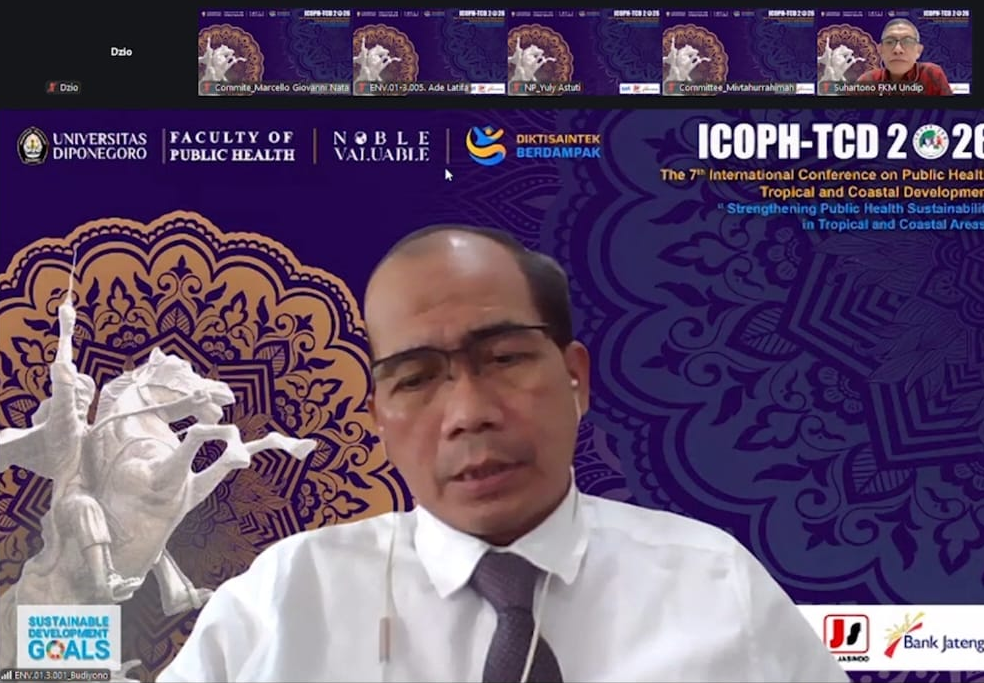


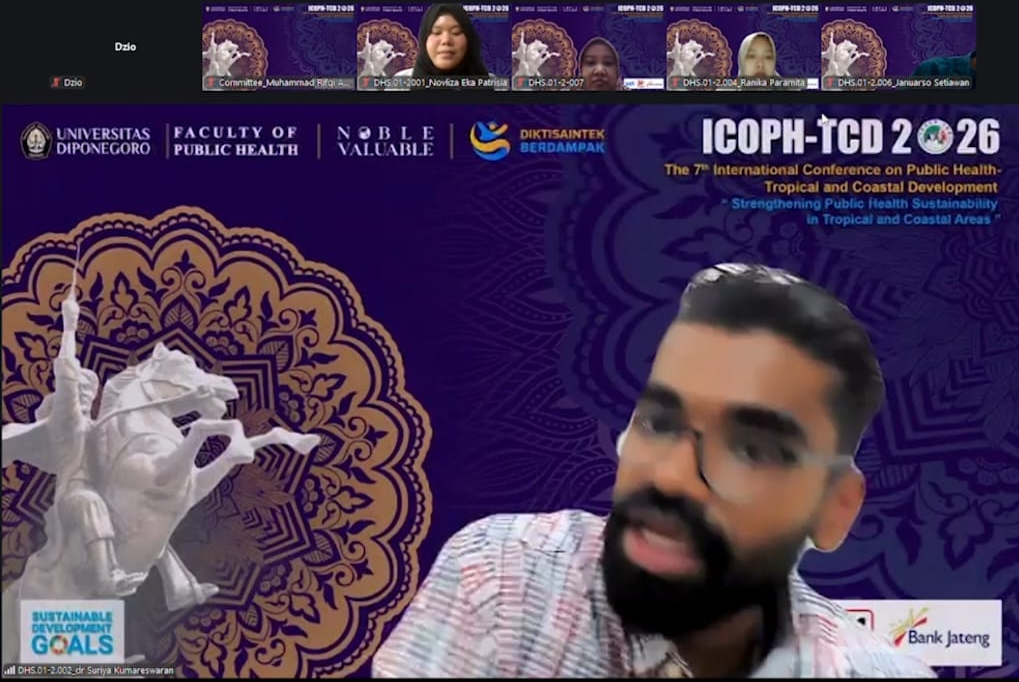
Presenters share research findings during an ICOPH-TCD 2026 parallel session. Scientific presentations were conducted in nine virtual rooms over two days.
The participation of 224 delegates from eight countries showed the breadth of interest in tropical and coastal public health. ICOPH-TCD 2026 brought academics, researchers, practitioners, students, and policymakers into one forum to connect scientific evidence with program needs on the ground.
ICOPH-TCD 2026 continued the international scientific forum conducted by the Faculty of Public Health, Universitas Diponegoro, since 2016. Through keynote addresses, plenary discussions, and research presentations, the conference expanded knowledge exchange and created further opportunities for research and education collaboration in tropical and coastal public health.