

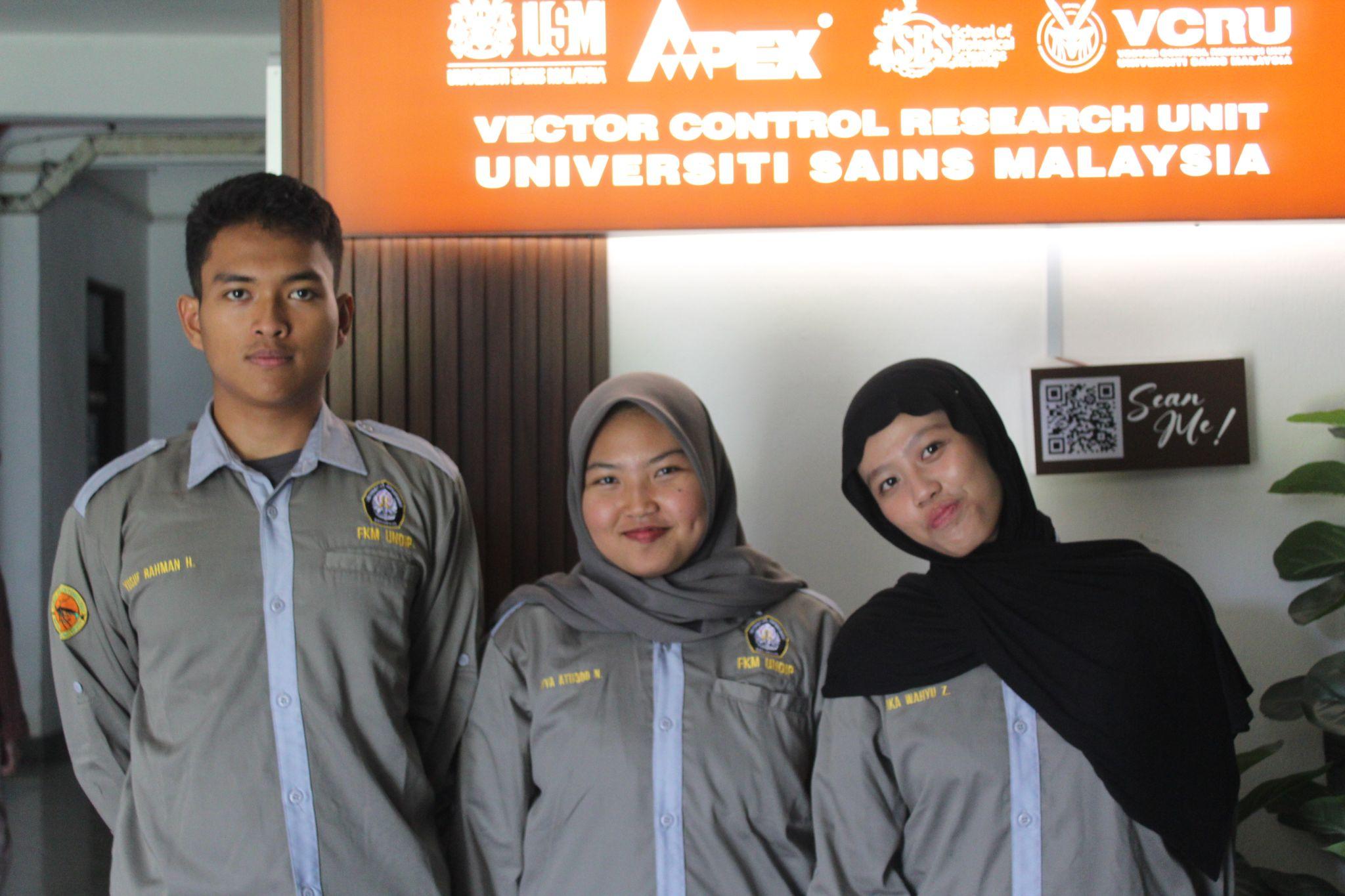
Penang, Malaysia – Three students from the Faculty of Public Health (FPH), Universitas Diponegoro (UNDIP), participated in an international training program entitled “Urban Pest Training and Molecular Analysis 10 Days” at Universiti Sains Malaysia (USM), Penang, Malaysia, from 18–28 June 2026. The program provided students with hands-on experience in urban pest management, molecular laboratory techniques, and bioinformatics analysis within an international academic environment.
The participants, Artika Wahyu Zulianty, Alifiyya Atiiqoo Nabiilaa, and Yusuf Rahman Hakim, took part in a structured series of laboratory training, bioinformatics sessions, and academic activities supervised by Prof. Ts. Dr. Abdul Hafiz Ab Majid. The program aimed to strengthen students’ technical competencies while providing opportunities to gain international academic experience and develop potential research networks between UNDIP and USM.
During the first week, the students participated in practical training on cockroach dissection and bacterial culture using streak plate and serial dilution techniques. They also learned the basic computational setup for bioinformatics analysis, including the installation of WSL, Ubuntu, and Conda, as well as data retrieval from online databases.
During the second week, the training focused on bioinformatics, data visualization, and molecular laboratory techniques. The students received QIIME2 training covering quality control, host decontamination, community profiling, alpha and beta diversity, and data deposition, followed by R-based visualization using bar plots, heatmaps, rarefaction curves, PCoA, and Venn diagrams. Molecular training included colony isolation, pure colony preparation, DNA extraction, gel electrophoresis, and PCR, followed by preparation and presentation of the training outcomes.
The knowledge and skills gained through the program are expected to support the participants’ undergraduate research and final projects, while also being disseminated among students and lecturers at FPH UNDIP. Furthermore, the program is expected to contribute to the development of future collaboration in education, research, and scientific activities, particularly in the field of urban pest management, while supporting Universitas Diponegoro’s internationalization agenda and its vision as a World Class University.