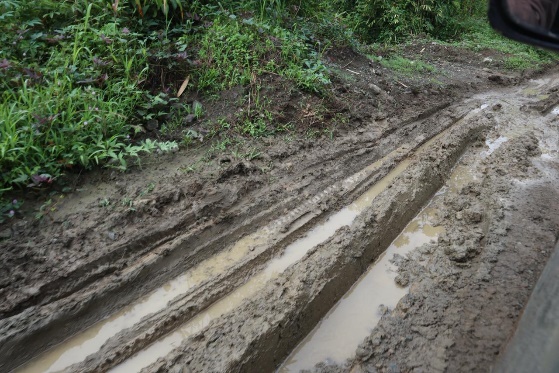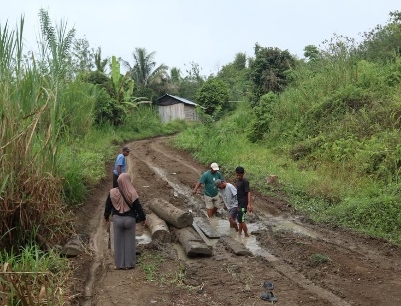
Road infrastructure limitations remain a major problem faced by transmigrants in Uematopa Village, Padauloyo Transmigration Area. The poor condition of the roads was revealed when the Padauloyo Undip Patriot Expedition Team, accompanied by field supervisor Muhammad Faiq Adi Pratomo, S.I.P., M.Sc., conducted direct observations in the field. The village road, which is the main access for residents, is not yet able to support the safe and smooth mobility of the community.
Uematopa Village is a Transmigration Settlement Unit (UPT) that began construction in 2022. As a transmigration area that is still in the early stages of development, the availability of basic infrastructure, especially roads, is still very limited. Moreover, during rainy weather, road access becomes difficult to navigate, thereby impacting residents’ activities, including access to health care facilities.
From the perspective of one team member, Annisatul Muniroh, a public health student, limited road access has the potential to pose serious health risks. Residents require longer travel times to reach the nearest health facilities, even in emergency situations. This obstacle increases the risk of delayed medical treatment, especially for vulnerable groups such as pregnant women and the elderly.
During interviews conducted by the team, Samuel, a community representative, said that residents of Uematopa Village face difficulties in accessing health facilities due to inadequate roads.
“There was an incident where a resident of our village died on the way to a health facility because of the long travel time,” said Samuel.
In addition to hindering access to health services, inadequate road conditions also have an impact on environmental health. Puddles along the road and unstable road surfaces have the potential to increase the risk of accidents and environment-based diseases. This situation shows that road infrastructure issues are closely related to efforts to improve the health of transmigrant communities.
Through the Patriot Expedition, the team sought to document the actual conditions in Uematopa Village as part of field-based health advocacy. These findings are expected to draw the attention of local governments and relevant stakeholders to accelerate road infrastructure development in transmigration areas. Adequate infrastructure is an important prerequisite for ensuring fair and sustainable access to health services for transmigrant communities.