
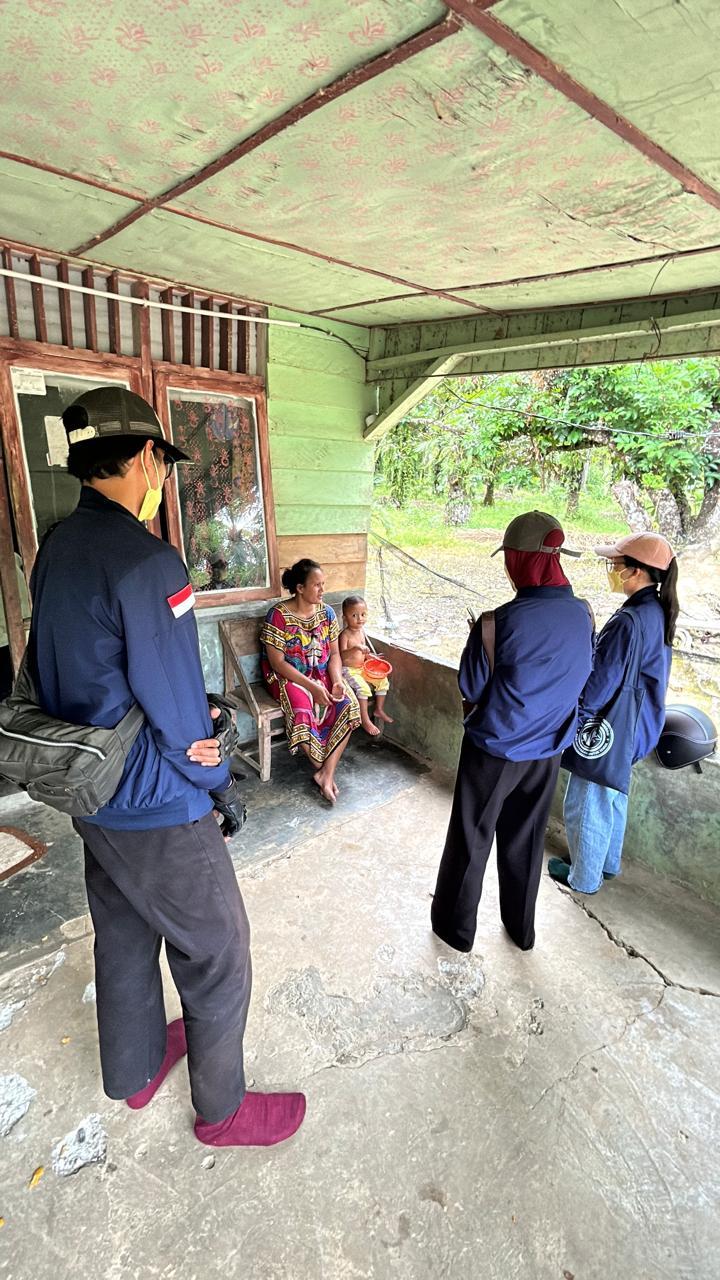
The implementation of the Patriot Expedition in Subulussalam City, Aceh Province, has revealed significant challenges related to access to health services and environmental health conditions in remote rural areas. One of the field activities was conducted in Suak Jampak Village through direct observation and in-depth interviews with local residents. The activity was carried out by Nafa’atul Manahil Salsabilla together with three other members of the Patriot Expedition team, under the supervision of Dr. Yusniar Hanani Darundiati, STP., M.Kes.
During the visit, the Patriot Expedition team engaged in a direct dialogue with Mrs. Lilis, a transmigrant resident originally from Tigalingga who has lived in Suak Jampak Village for several years. Based on the interview, it was found that access to the village remains highly limited and requires serious attention. The village is located far from the center of Subulussalam City as well as from the sub-district where the nearest community health center (puskesmas) is located, resulting in significant barriers for residents in accessing basic health services.
Administratively, Suak Jampak Village has a Village Health Post (Poskesdes). However, the facility is not functioning effectively due to the absence of health personnel, particularly a village midwife. According to Mrs. Lilis, the midwife who previously served the village has no longer been present since the period of pregnancy and postnatal care, leaving residents without access to essential primary health services within the village.
These limitations have had direct consequences in emergency situations. Mrs. Lilis shared her experience when her child suffered a burn injury caused by hot cooking oil, resulting in blistered skin. At the time of the incident, the family faced serious difficulties in obtaining medical assistance due to the absence of health workers in the village, the lack of nearby clinics, and the unavailability of a village ambulance. In addition, road access to health facilities is in poor condition, unlit, and characterized by multiple road branches without clear signage, making travel particularly difficult at night.
To reach health services, residents of Suak Jampak Village must travel long distances to Subulussalam City or pass through the oil palm plantation area of PT Asdal, which lacks street lighting, before diverting toward Aceh Selatan Regency. This situation illustrates how geographical barriers and inadequate infrastructure continue to be major obstacles to equitable access to health services for rural communities.
Beyond health service accessibility, environmental health conditions in Suak Jampak Village also present serious concerns. Access to clean water is extremely limited, with two households often relying on a single well whose water quality has become turbid and unfit for consumption. As a result, residents are forced to collect water from a nearby river, which is difficult to access due to challenging terrain. These conditions are further exacerbated by annual flooding, which increases the risk of water contamination and the incidence of environment-related diseases.
Through the Patriot Expedition activities, the team sought to document firsthand the realities of public health and environmental conditions in remote areas. The findings from Suak Jampak Village indicate that public health challenges cannot be separated from environmental conditions and basic infrastructure availability. It is expected that these findings can serve as an important reference for stakeholders in efforts to improve health service equity and environmental quality in rural and underserved communities.