

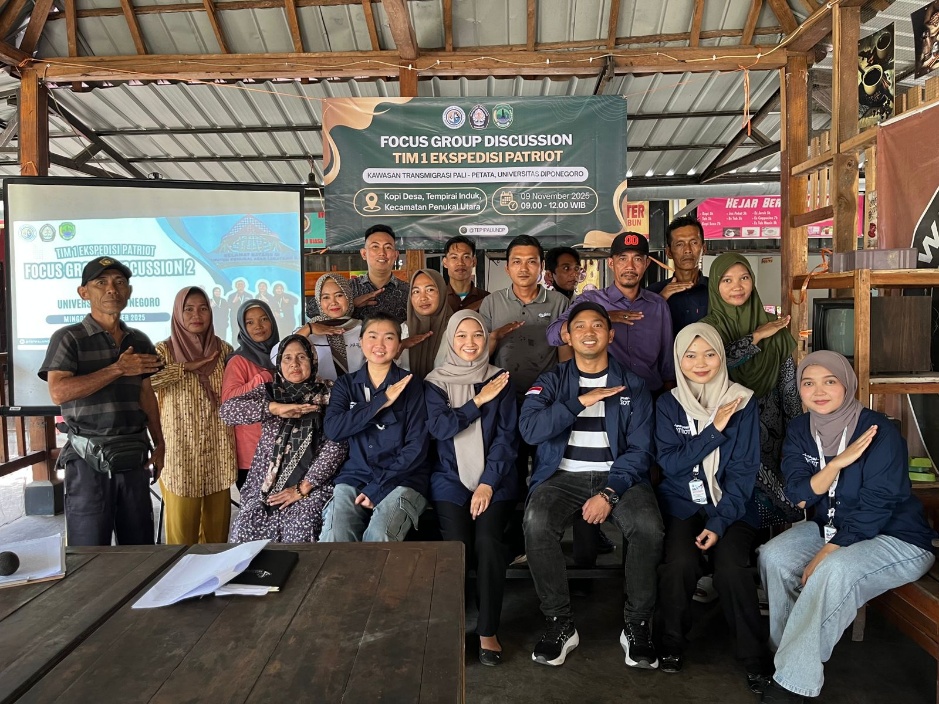
Fundamental problems continue to affect the Petata transmigration area in Penukal Abab Lematang Ilir (PALI) Regency, South Sumatra. One of the most pressing issues is limited access to clean water, as highlighted during a Focus Group Discussion (FGD) held on Monday, 9 November 2025, in Tempirai Induk Village.
During the forum, residents from several transmigration villages openly voiced their concerns regarding difficulties in accessing clean water for daily needs. The discussion, attended by Team 1 of the Patriot Expedition with the involvement of students from the Faculty of Public Health, Universitas Diponegoro, served as a platform for community members to convey their aspirations, experiences, and real challenges at the grassroots level.
A traditional leader from Karang Tanding Village, Sulani, emphasized that the primary issue in the transmigration area is not flooding but drought, which frequently occurs during the dry season.
“In transmigration areas, the main problem is not flooding but the dry season. Wells have been dug, yet even at depths of up to 15 meters, no water can be found. This is the main obstacle in transmigration areas,” he said.
These complaints reflect the complexity of environmental challenges faced by the Petata transmigration community. Although flooding affects several villages at certain times, drought represents a far more serious problem, as it directly impacts the fulfillment of clean water needs for consumption, sanitation, and other domestic activities. Limited access to adequate water infrastructure, such as PDAM networks and drilled wells, has forced some villages to rely on rainwater and river sources.
A similar concern was raised by Nato, a resident of Suka Maju Village, who stated that his area has been experiencing prolonged drought. He revealed that residents have proposed the construction of a large-scale water retention basin (embung) as a long-term solution.
“Suka Maju is experiencing drought. Residents are requesting the construction of a large-scale embung. Once the embung is built, the water can be utilized as a PDAM supply and distributed to households. With PDAM access, we will no longer need to struggle to collect water from the river,” he explained.
The series of complaints raised during the FGD underscores that the clean water crisis in the Petata transmigration area remains an unresolved structural issue. Dependence on unsustainable water sources and inadequate supporting infrastructure highlights environmental vulnerability that directly affects public health. This situation requires serious attention from local governments and relevant policymakers to deliver planned and sustainable solutions.
Several measures are considered essential, including strengthening clean water infrastructure through the construction of water retention basins and the expansion of distribution networks, developing rural drinking water supply systems adapted to local geographical conditions, and utilizing appropriate technologies such as rainwater harvesting. In addition, integrating clean water issues into regional development planning, strengthening the role of village governments, and ensuring active community participation in the management of water facilities are key to achieving service sustainability.
Efforts to improve clean water access must also be accompanied by environmental health education and equitable budgeting to prevent transmigration communities from remaining vulnerable due to limited access to safe water. Without comprehensive, cross-sectoral policy interventions, the clean water crisis in the Petata transmigration area is likely to persist and continue to undermine quality of life and public health.